What is the best meal planning app for one person?
Almost every planner is built for a household and left to scale down on its own. Cooking for one changes the portions, the leftovers and the arithmetic of a subscription, so it changes the answer too.
The answer turns on money as much as food.
For most people cooking for one, the best meal planning app is usually the one you stop paying for, and that is Paprika 3, which costs $4.99 once and holds 4.90 stars from 53,706 ratings on the US App Store. If you would rather spend nothing, SuperCook is free with no in-app purchases listed and works from ingredients you already have, and Samsung Food plans a whole week for nothing, with an optional premium tier at $6.99 a month.
We make one of those subscription apps, WhatsCook.ing, so read this as a comparison written by a competitor. Figures come from our comparison page, read on the App Store on 9 September 2026. Our own weak points for a single cook are near the bottom.
Portions are not a division problem.
Recipe libraries are written for four, and cutting one down is rarely a matter of dividing, because ingredients do not come in quarters. Half an onion, a third of a tin, one thigh from a pack of six. The waste is created when the plan is written, so an app that lets you type "1" into a servings box has solved the arithmetic and none of the shopping list.
Leftovers are the whole game.
In a household, leftovers are somebody's lunch. Alone, a recipe for four is the same dinner on Tuesday, Wednesday and Thursday, and that repetition is why plans get abandoned in week two. The useful question is whether next week's plan starts from the half tin left in the fridge.
Waste costs more per head.
A bunch of coriander bought for one recipe has to be finished by one person. The spinach, the feta, the rest of the tortillas: each is a small deadline. An app that builds its list from its own recipes, rather than the gaps in your kitchen, sells you new deadlines weekly.
Nobody else is waiting for dinner.
No feature list covers this. Cooking for a household has a built-in reason to happen. Cooking for one does not, so the app that survives makes the decision small on a Tuesday when you would rather order in. Four dinners you can already make is small. Forty items on a list is not.
A subscription meets one grocery bill, not four.
A family can say a planner pays for itself in one avoided takeaway. For one person the same fee sits against a smaller food spend, so it has to work harder. Anything with a monthly fee must justify itself against one grocery bill instead of four, a harder test than app makers admit. That is why a one-time payment suits single cooks more than anyone else.
Paprika 3: the safest answer, because you stop renting.
$4.99 once, 4.90 stars from 53,706 ratings, the highest in our comparison set. It stores the recipes you save, builds grocery lists from them, and lets you place them on a calendar by hand. It does not look in your kitchen and tracks no nutrition, so the planning stays your job. Paying once also ends the monthly question of whether it still earns its keep.
SuperCook: free, and shaped like the right question.
Free, no in-app purchases listed, 4.82 stars from 21,712 ratings. You tick your ingredients and it shows recipes needing only those, the right shape for using up what is open. It finds tonight rather than a week, builds no list from gaps and carries no nutrition.
Samsung Food: a free week, built from a recipe box.
Free, premium $6.99 a month or $59.99 a year, 4.78 stars from 6,333 ratings. It saves recipes from around the web and plans a week from them, a good deal at zero. The catch is the starting point: it begins from recipes you liked, not the food you have to finish, so the list is the whole recipe.
Mealime: good, and closing on 21 October 2026.
It rates 4.81 stars from 53,992 ratings, near the top of this whole category, and its own subtitle is the plainest description of the job: "Meal Planner & Grocery List". Its own closing notice says the app will be discontinued as of October 21, 2026, and that personal data is deleted at shutdown. Members should see what to use instead and how to save recipes first.
Eat This Much: right if your targets matter more than your fridge.
4.72 stars from 22,087 ratings, in-app tiers from $8.99 to $84.99. It plans from your calorie and macro targets, your budget and your schedule, and has a virtual pantry too, the closest mainstream planner to one that looks at what you own.
Cooklist: the least typing, with one blind spot.
4.73 stars from 11,292 ratings, Pro $5.99 to $9.99 a month, $49.99 or $59.99 a year. It fills a pantry from your grocery loyalty card, the smallest effort any pantry here asks. The blind spot matters more when you cook for one: a receipt knows what you bought, not what is left.
Cronometer and Cal AI are not planners.
Cronometer holds 4.77 stars from 97,718 ratings and Cal AI holds 4.80 from 361,529, but neither decides dinner and neither knows your kitchen. Pair one with a planner.
WhatsCook.ing: one serving by default, last week's food carried forward.
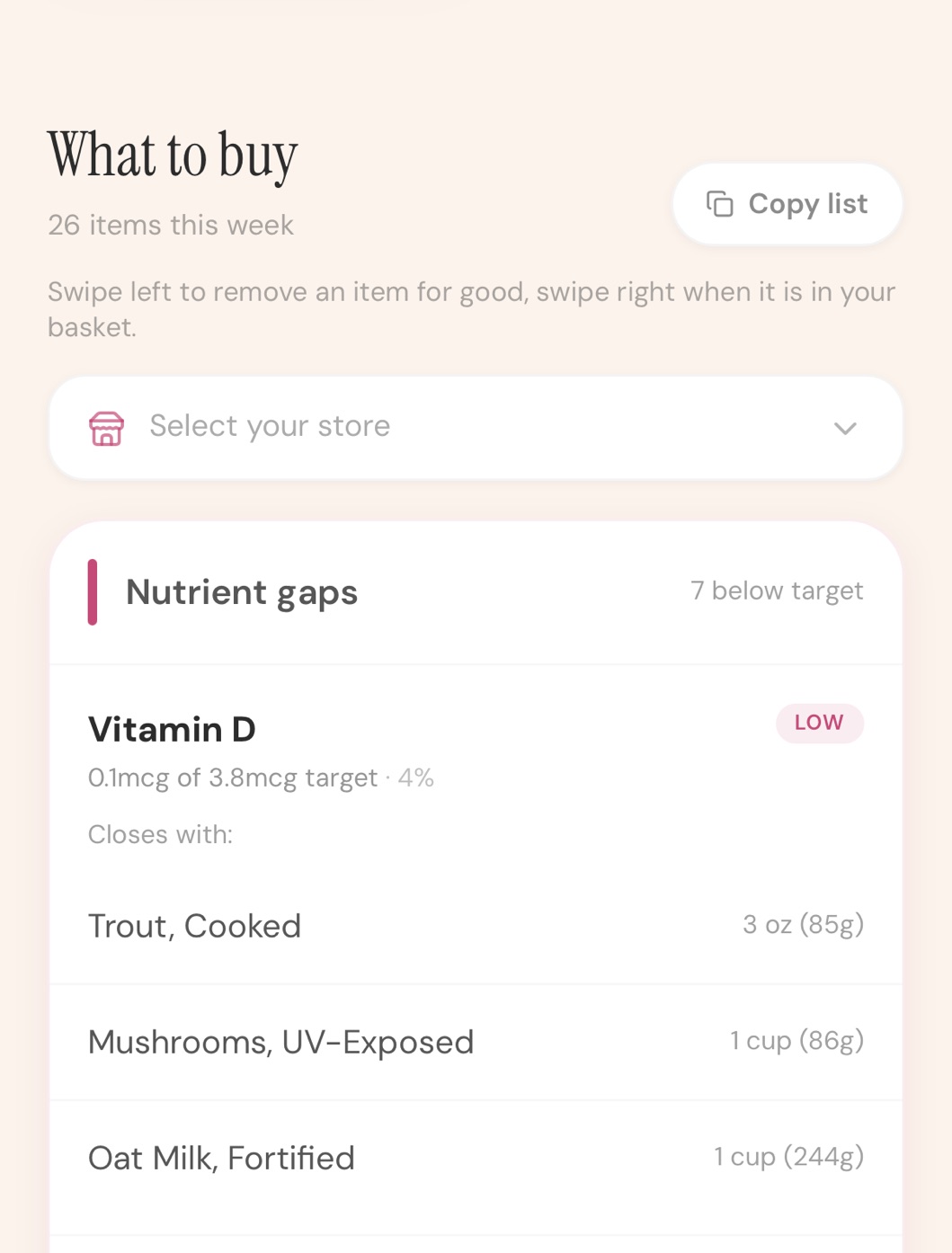
Two things here suit a single cook. Recipes are written for one serving, with nutrition computed from the ingredients, so there is no scaling step. And the pantry is a running picture, not a snapshot: you photograph the shelf, amounts come down as you cook, and the next week starts from what is left. The half tin and the rest of the coriander are still counted.
The shopping list is only the gaps, so it tends to be short. If you ask for a week built strictly from the shelf and a whole food group is missing, the app says so before it starts and writes four days instead of seven. Four days there is the intended result, not a fault. Cooking a meal is the whole logging step, and the day is scored across four pillars, which moves a BioAge estimate. BioAge is a nutrition-derived estimate with its method shown in the app. It is not a medical measurement and not a diagnosis.
The price is hardest to defend for exactly this reader.
WhatsCook.ing is $29.99 a month or $179.99 a year, about $15 a month on the annual. It is the most expensive line on our own comparison table, and the case for it rests on avoided waste and avoided takeaway, both smaller numbers for one person. Paprika is $4.99 once and Samsung Food is free. If your waste is already low, they are better value.
The questionnaire is long and the first plan is not instant.
Before the first week you answer questions about diet, allergies, goals and body metrics, and you must enter a pantry before it will plan. The first plan then takes three to four minutes. A household spreads that setup across several people's dinners. For one person it is just a chunk of a Sunday.
The other honest limits.
There is no free tier: the first 7 days are a free trial through your Apple Account, and after that nothing is free. It is an iPhone app, with no Android and no web version. It does not order groceries, has no barcode scanner, and does not estimate calories from a photo of a plate. It is not on the App Store yet, so there are no ratings to weigh against Paprika's 53,706.
Every figure above, and where it came from.
Prices, star ratings and rating counts are what Apple showed on the US App Store on 9 September 2026, read again on 21 September 2026. Counts rise daily, so treat them as a snapshot.
App Store listings, all read 9 September 2026: Paprika Recipe Manager 3, SuperCook, Samsung Food, Mealime, Eat This Much, Cooklist, Cronometer and Cal AI.
Mealime's closing notice, for the 21 October 2026 date and the deletion of personal data, read 14 September 2026.
On its way to the App Store.
WhatsCook.ing is finishing its App Store submission. Leave your email and we will write once, on the day it is live, and never for anything else.
7-day free trial through your Apple Account, then $29.99 a month or $179.99 a year. iPhone only.