How do I plan a week of meals without going to the store?
The answer is a method rather than an app. It takes twenty minutes the first time and it works in a notebook. Three tools worth knowing about are at the end.
Start from an inventory instead of a recipe. Write down everything you already have, pick the two or three heavy ingredients that can carry more than one dinner, choose recipes loose enough to bend around what you own, and cook the food that spoils first. Count roughly two dinners per heavy ingredient, so three or four of them is most of a week, and whatever is still missing after that is your whole shopping list.
The five steps below are the same thing slowed down, with three honest tools at the end.
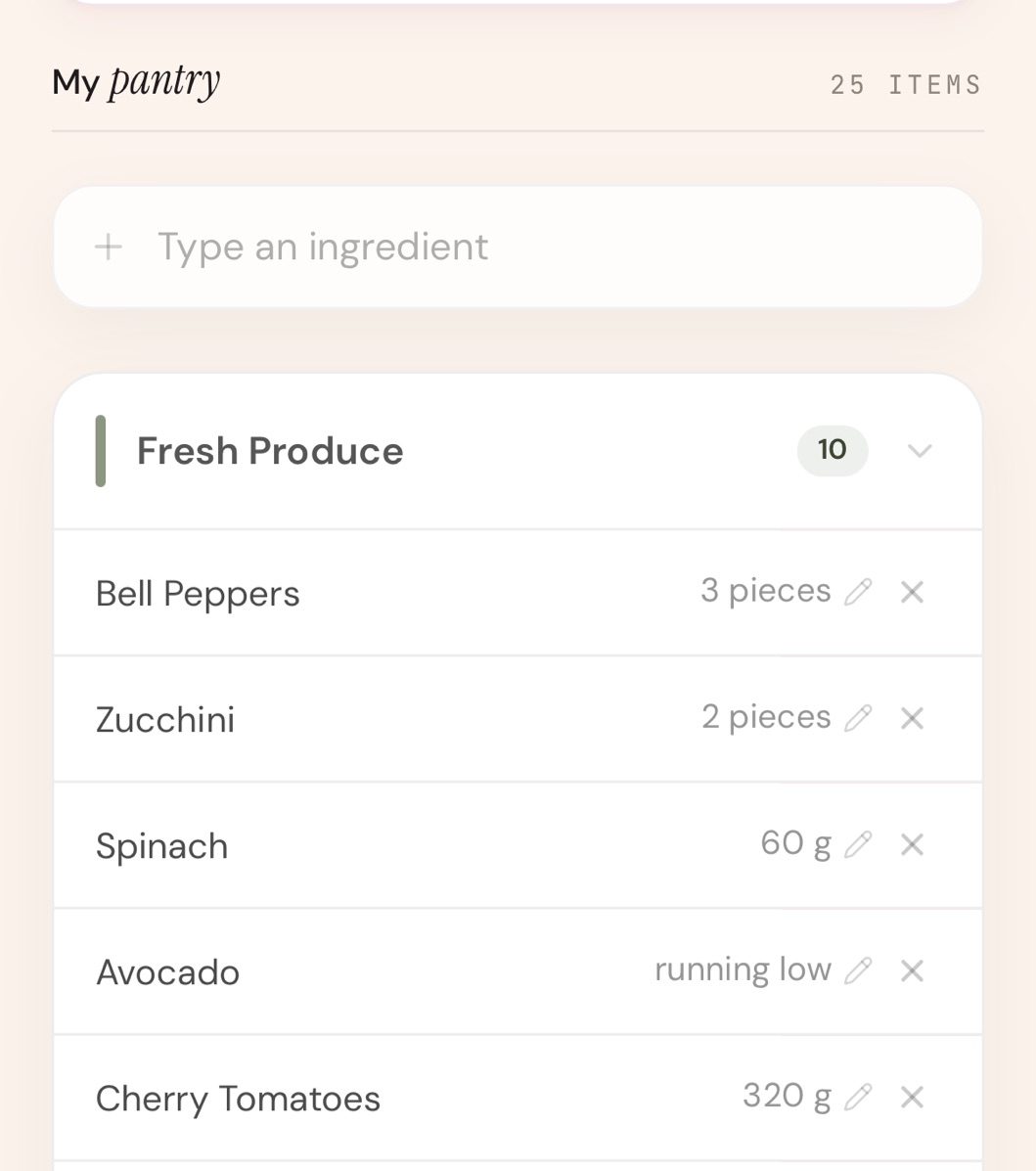
Write down what you actually have.
Twenty minutes, three places, one list. Open the fridge, the freezer and the cupboard and write down what is in them, not what you believe is in them. The gap between believing and knowing is where the week goes missing.
Write rough quantities. "Rice" is not useful. "Most of a large bag of rice" tells you it is four dinners. "Half a bag of frozen peas" tells you it is a side, not the vegetables for a week.
Mark two things: what is close to turning, which sets the cooking order, and what has sat there for months, which is what you keep buying again.
Find the anchors.
An anchor is a heavy ingredient that can carry a dinner on its own: a bag of rice or pasta, a dozen eggs, dried lentils, chicken thighs in the freezer, a block of tofu, a bag of potatoes, four cans of tomatoes.
Count yours. One anchor is roughly two dinners before it feels repetitive, so four anchors is most of a week. If you only have two, you are planning four days rather than seven, and it is better to know that now than on Thursday evening.
An anchor is not the whole meal. It is the part that decides the meal exists at all.
Use recipes with a shape, not a list.
A recipe with a fixed ingredient list is a shopping list in disguise. A recipe with a shape is a set of slots you fill from whatever the inventory holds.
Six shapes cover most weeks. A grain bowl or fried rice: grain, protein, any two vegetables, something sharp. A frittata: eggs, whatever is in the fridge, cheese if there is any. A soup: onion, whatever roots exist, stock, a starch to thicken it. A sheet-pan dinner: protein, hard vegetables, oil, one strong flavor. A dal or a bean stew: pulses, onion, spice, fat. Pasta: the pasta, one fat, one salty thing, one green thing.
Write the shape first, then fill the slots from your list. This is the step that turns "there is nothing to eat" into four dinners. The food was always there. Fixed recipes made it look otherwise.
Write the gaps list last.
Only now, with the dinners drafted, look at what is missing. A gap is something without which a dinner does not happen: no oil, no onions, no stock. Not something that would merely make it nicer.
Kept honest, the list is short. Something acidic, something fresh and green, and one protein if the anchors came up thin. Six things rather than forty.
The order is the whole trick. Writing the list before the plan is how you end up with a second jar of cumin and still no idea what Wednesday is.
Cook in the order things go bad.
The week has an order and it is not the order you feel like. Fresh fish first, then soft leaves and berries, then soft herbs, then mushrooms and zucchini, then dairy and anything already cooked. Hard roots, cabbage, onions and everything frozen or dried go last, because they will wait.
So the salad is Monday and the lentils are Saturday, even when you want it the other way round. That one rule is most of the difference between a week that gets eaten and two bags of leaves in the bin.
One exception. If something is on the edge tonight, cook it tonight. Cooking it buys time that leaving it raw does not.
The honest limits of cooking from the shelf.
Protein and fresh vegetables are the two things a cupboard cannot fake, and when they are gone the week is genuinely four days rather than seven. Forcing it to seven is how people end up eating pasta with oil twice.
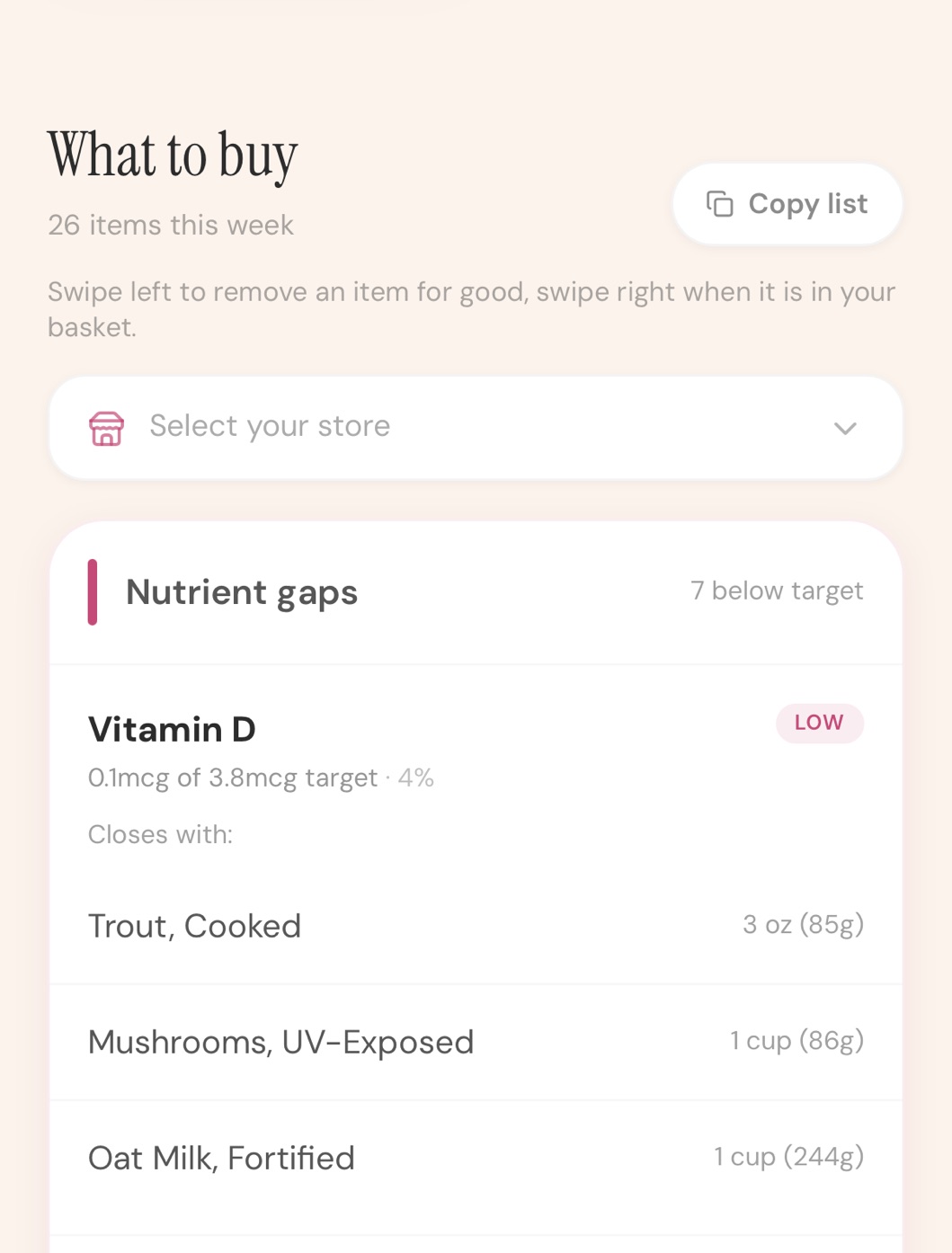
Nutrition drifts too. A week from a thin pantry leans on grains and goes light on greens and protein: fine for one week, not fine as a habit. Run the kitchen down on purpose, then shop properly.
And it costs attention every week: the inventory, the shapes, the order. That is the part software can take off you.
SuperCook, if you want free and tonight.
You tick your ingredients from its list and it shows recipes that use only those. It is free with no in-app purchases listed, and it holds 4.82 stars from 21,712 ratings, read on 9 September 2026. It runs on iPhone, iPad and the web.
What it does not do is the week. It answers "what can I make right now", not "what are the next five dinners, in what order". No plan, no gaps list, no nutrition. For step three it is useful.
A plain notes app, if you want free and yours.
This method was written for paper, so any notes app runs it: one note for the inventory, one for the shapes, one for the gaps. Nothing leaves your phone and no company can discontinue it.
The cost is that you do all of it, every week, including the arithmetic about whether four anchors is really seven dinners. That is the part that gets skipped first.
WhatsCook.ing, if you want it done for you and you will pay for that.
We make this one, so weigh it accordingly. You photograph the shelf instead of writing the inventory, the week is written from what is there, and the list is only the gaps. Cooking a meal logs it, and the nutrition of what you cooked moves a BioAge, a nutrition-derived estimate with its method shown in the app, not a medical measurement.
The limits, in writing. iPhone only, no Android and no web. No free tier: the first 7 days are a free trial through your Apple Account, then $29.99 a month or $179.99 a year, the most expensive price on our own comparison page. No grocery ordering, no barcode scanner, no calorie estimate from a photo of your plate. The questionnaire is long and the first plan takes three to four minutes. It is finishing its App Store submission, so there is nothing to install today.
Like the method above, when the pantry is thin it writes four days and says so first, rather than inventing ingredients you do not own.
Related pages.
On the photograph part: is there an app that makes a meal plan from what is in my fridge. On cooking for one: the best meal planning app for one person. On plans that carry a nutrition number: which meal planning apps track nutrition, not just recipes.
Mealime's closing notice says the app will be discontinued as of October 21, 2026, so its members have what to use now and the longer Mealime alternative page.
For the wider field, ten meal planning apps compared holds every price and rating quoted here, and the questions page answers the practical ones about this app.
Where the figures come from.
SuperCook's price, rating and platforms are what Apple showed on the US App Store. Rating counts move daily.
SuperCook, Recipe By Ingredient on the App Store, read 9 September 2026.
Mealime's closing notice at mealime.com/closing, read 14 September 2026 and checked again 21 September 2026, for the 21 October 2026 closing date.
The WhatsCook.ing prices and limits come from the app itself, which is not on the App Store yet and has no rating.
On its way to the App Store.
WhatsCook.ing is finishing its App Store submission. Leave your email and we will write once, on the day it is live, and never for anything else.
7-day free trial through your Apple Account, then $29.99 a month or $179.99 a year. iPhone only.