How do I get a high-protein meal plan with a grocery list?
Three steps: set the number, split it across the day, and put the protein at the top of the list.
Set a target, give every meal a share, and shop for the protein first.
Set a protein target, give every meal a share of it, and buy the protein foods before anything else. Eat This Much builds a week to your calorie and macro targets and emails a grocery list, from $8.99 a month. WhatsCook.ing, an iPhone app, sets your protein target from your body weight, raised by the goals you choose, and plans the week from it and your kitchen, for $29.99 a month or $179.99 a year on the US App Store.
We make one of the apps below, so read this as a competitor's guide. Section seven says where ours is the wrong choice. This page gives general reference figures, not medical advice.
How much protein is enough?
The US Recommended Dietary Allowance for adults is 0.8 g of protein per kilogram of body weight a day, set by the Institute of Medicine (now the National Academy of Medicine) in its 2005 Dietary Reference Intakes. For someone who weighs 70 kg (154 lb), that is 56 g a day.
The figure has barely changed since 1941, and a 2023 review in Nutrients asks whether it should be reconsidered. If you have kidney disease, are pregnant, or follow a diet set by a clinician, take your number from them rather than from any page or app.
Protein in twelve everyday foods.
Figures per 100 g and per everyday portion, from USDA FoodData Central. The last number column shows how much protein each food gives per 100 calories, which matters when you are also watching calories.
The table scrolls sideways on a phone.
| Food | Protein per 100 g | Calories per 100 g | A typical portion | Protein per portion | Protein per 100 calories | FDC ID |
|---|---|---|---|---|---|---|
| Chicken breast, meat only, roasted | 31.0 g | 165 | 120 g cooked | 37.2 g | 18.8 g | 171477 |
| Eggs, whole, hard-boiled | 12.6 g | 155 | 2 large eggs (100 g) | 12.6 g | 8.1 g | 173424 |
| Greek yogurt, plain, nonfat | 10.2 g | 59 | 1 pot (170 g) | 17.3 g | 17.3 g | 170894 |
| Cottage cheese, lowfat 1% | 12.4 g | 72 | Half a cup (113 g) | 14.0 g | 17.2 g | 173417 |
| Tuna, light, canned in water, drained | 25.5 g | 116 | 100 g drained | 25.5 g | 22.0 g | 171986 |
| Salmon, Atlantic, farmed, cooked | 22.1 g | 206 | 120 g cooked | 26.5 g | 10.7 g | 175168 |
| Tofu, firm | 17.3 g | 144 | 120 g | 20.8 g | 12.0 g | 172475 |
| Tempeh | 20.3 g | 192 | 100 g | 20.3 g | 10.6 g | 174272 |
| Lentils, boiled | 9.02 g | 116 | 1 cup cooked (198 g) | 17.9 g | 7.8 g | 172421 |
| Chickpeas, boiled | 8.86 g | 164 | 1 cup cooked (164 g) | 14.5 g | 5.4 g | 173757 |
| Black beans, boiled | 8.86 g | 132 | 1 cup cooked (172 g) | 15.2 g | 6.7 g | 173735 |
| Peanut butter, smooth | 22.2 g | 598 | 2 tablespoons (32 g) | 7.1 g | 3.7 g | 172470 |
Beans, lentils and chickpeas are boiled without salt. Portions are ours; protein per portion is the USDA figure per 100 g multiplied by the portion's weight.
What does a 100 g day look like?
Split the target across the meals you actually eat, so no single meal has to carry it. Using the table above:
Breakfast: a 170 g pot of nonfat Greek yogurt (17.3 g) and two hard-boiled eggs (12.6 g), 29.9 g. Lunch: 100 g of canned tuna (25.5 g) on a cup of chickpeas (14.5 g), 40.0 g. Dinner: 120 g of salmon (26.5 g). A snack of two tablespoons of peanut butter (7.1 g). That comes to about 103 g, before the bread, rice and vegetables, which add a few grams more.
If one meal falls short, you know by how much, and the next meal can make it up.
Why shop for the protein first?
Write the protein foods at the top of the list, with amounts for the whole week: if dinner needs 120 g of tofu on four nights, that is 480 g. Then the vegetables and grains that go with them, then everything else. If the money or the trip runs short, the part that carries your target is already in the basket.
Mix fresh and long-keeping proteins. Canned tuna, canned or dried beans and lentils, and peanut butter wait in the cupboard; fresh chicken and fish go on the first nights of the week.
Apps that plan or track to a protein target.
The table scrolls sideways on a phone.
| App | Plans the meals | Protein | Uses what you own | Grocery list | Tracks what you ate | Price |
|---|---|---|---|---|---|---|
| Eat This Much | Yes, a week to your calorie and macro targets | Part of your macro targets | Not stated | Yes, emailed with the plan | Yes, what you did or did not eat | Free download. In-app purchases from $8.99 a month |
| Samsung Food | Food+ adds plans tailored to your health goals | Not stated | Food+ adds pantry management | Yes, from your plan | Food+ adds nutrition tracking | Free. Food+ $6.99 a month or $59.99 a year |
| MyFitnessPal | Premium Plus adds personalized meal plans | Macro tracking against your goals | Not stated | Premium Plus adds grocery delivery integration | Yes, logged from its food database | Free download. Premium in-app purchases from $9.99 to $79.99. Premium Plus price not shown on the listing |
| Cronometer | No, you log what you eat | Tracks protein with the other macros and micronutrients | Does not plan meals | Not stated | Yes, logged against its food database | Free download. Gold $10.99 a month or $59.99 a year |
| WhatsCook.ing | Yes, a week from your goals, your tastes and your kitchen | A target set from your body weight, raised by your goals | Yes. By default every meal cooks from what you own | Led by your nutrient gaps | Yes, one tap for a planned meal, a photo or a few words for anything else | $29.99 a month or $179.99 a year, after a 7-day free trial |
What WhatsCook.ing does, and what it costs.
WhatsCook.ing sets your protein target from your body weight, raised by the goals you choose, and your calorie target with the Mifflin-St Jeor formula. It writes a week of meals from those targets, your tastes and what is in your kitchen, which it reads from a pantry photo or a typed list.
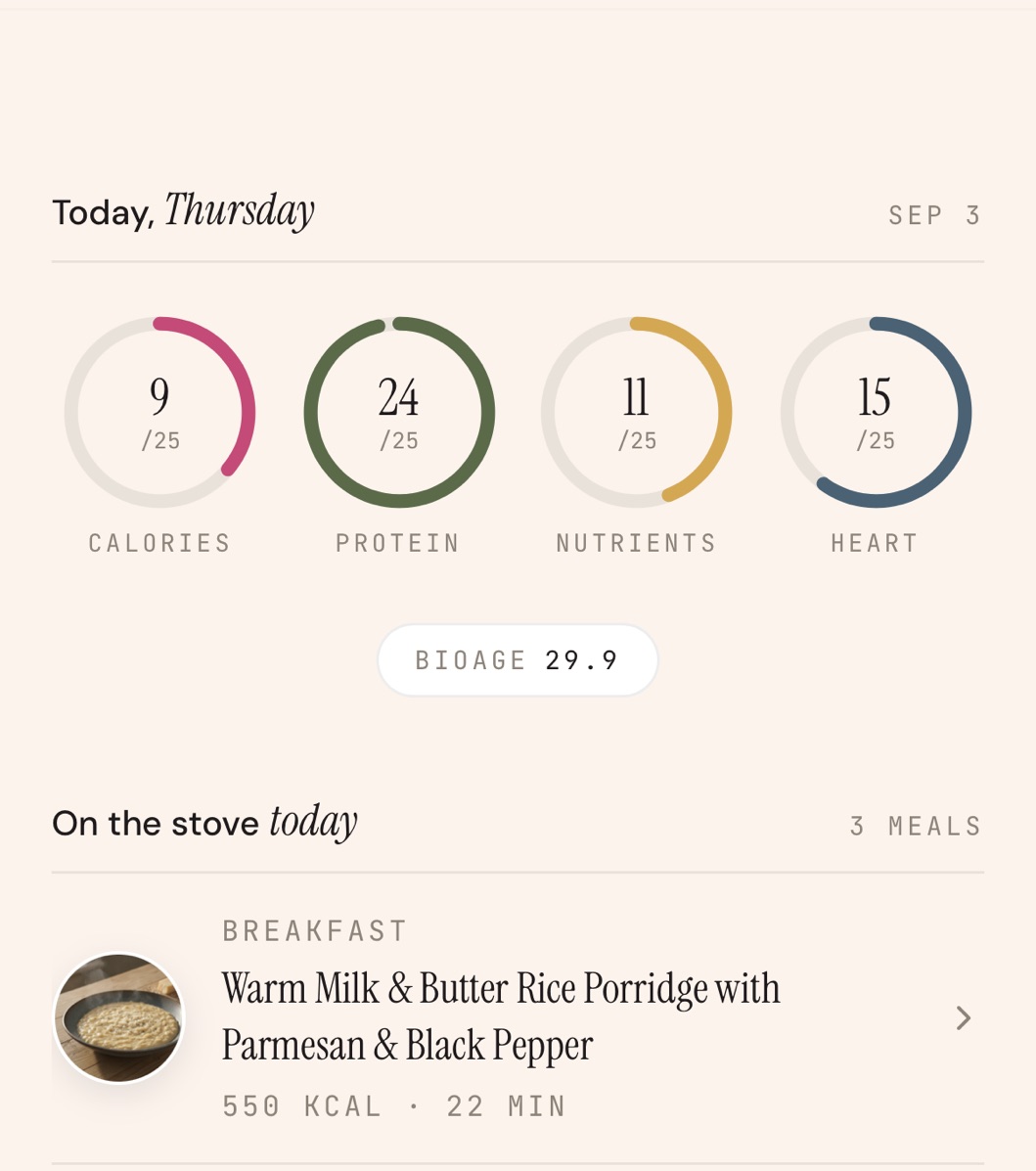
Every meal you log is read for calories, protein, carbohydrate, fat, fiber, sugar and sodium, plus iron, calcium, vitamin C, vitamin D and omega 3. Protein is one of four pillars, 25 points each: it scores how far you got toward your target, with full marks once you reach it, rather than pass or fail. The shopping list leads with the foods that close your nutrient gaps.
It is $29.99 a month or $179.99 a year on the US App Store, after a 7-day free trial through your Apple Account. Cancel at least 24 hours before the trial ends and you pay nothing.
Where it is the wrong choice.
If you want to weigh and log every gram against a large food database, Cronometer is the careful tracker. If you want a plan built to exact macro targets for less, Eat This Much starts at $8.99 a month. If you already know what to cook and only need the numbers, the table above and a notebook are free.
WhatsCook.ing is an iPhone app, with no Android version, and it has no barcode scanner. It costs more than every other price shown in the table.
How much protein do I need a day?
The US Recommended Dietary Allowance for adults is 0.8 g of protein per kilogram of body weight a day, which is 56 g for someone who weighs 70 kg (154 lb). Researchers still debate whether the figure should be higher. If you have kidney disease, are pregnant, or follow a diet set by a clinician, ask them for your number.
Which foods give the most protein per calorie?
Of the twelve everyday foods in our USDA table, canned light tuna in water gives the most, 22.0 g of protein per 100 calories. Then come roasted chicken breast at 18.8 g, nonfat plain Greek yogurt at 17.3 g and 1% cottage cheese at 17.2 g. Peanut butter gives the least, 3.7 g per 100 calories.
Is there an app that makes a high-protein meal plan with a grocery list?
Several. Eat This Much plans a week to your calorie and macro targets and emails a grocery list, from $8.99 a month on the US App Store. Samsung Food+ and MyFitnessPal Premium Plus both sell meal plans tailored to your goals. WhatsCook.ing, an iPhone app, sets your protein target from your body weight, raised by the goals you choose, and writes the week from it and what is in your kitchen, at $29.99 a month or $179.99 a year on the US App Store.
Can I hit a protein target as a vegetarian?
Yes, with more planning per meal. From the USDA table: 170 g of nonfat Greek yogurt gives 17.3 g, 120 g of firm tofu 20.8 g, 100 g of tempeh 20.3 g and a cup of cooked lentils 17.9 g. Two of those at each of three meals come to more than 100 g a day. In WhatsCook.ing, vegetarian means plant based plus dairy with no eggs, and eggitarian adds eggs, so pick the one that matches how you eat.
Five pages that go deeper.
Which apps carry nutrition through the week, on meal planning apps that track nutrition. Fixed menus against planning apps, on meal plan services with a grocery list. A quick method on planning a week of dinners in 15 minutes. Ten apps in one table on the comparison page. And the questions page, on price, diets and BioAge.
Every figure above, and where it came from.
Protein and calories per 100 g are from USDA FoodData Central, SR Legacy data, read on 5 October 2026; each row carries its FDC ID, which you can search on that site. Protein per portion and per 100 calories are our arithmetic on those figures.
The 0.8 g per kilogram allowance is from the Institute of Medicine's Dietary Reference Intakes for Energy, Carbohydrate, Fiber, Fat, Fatty Acids, Cholesterol, Protein, and Amino Acids (2005), as summarised in "Is It Time to Reconsider the U.S. Recommendations for Dietary Protein and Amino Acid Intake?" (Nutrients, 2023). 56 g is 0.8 multiplied by 70.
App prices and features are what Apple showed on the US App Store on 5 October 2026: Eat This Much, Samsung Food, MyFitnessPal, Cronometer and WhatsCook.ing.
On the App Store now.
Your week of meals planned from your goals, your tastes and your kitchen, every meal read nutrient by nutrient, and a shopping list led by your nutrient gaps.
Download on the App Store7-day free trial through your Apple Account, then $29.99 a month or $179.99 a year on the US App Store; other App Store countries show local prices. iPhone only.