What is the best AI meal planner app?
It depends on where your week starts: a chat, a calorie target, a box of saved recipes, the nutrients you are short on, or your own kitchen.
Five AI meal planners, five starting points.
It depends on where the week starts. ChatGPT can write a week of meals and a grocery list from what you tell it. Eat This Much plans to your calorie and macro targets. WhatsCook.ing, an iPhone app, plans a week from your goals, your tastes and a pantry you add by photo or by typing, then reads every meal you log. It is $29.99 a month or $179.99 a year on the US App Store.
We make one of the apps below, so read this as a competitor's guide. Section five says where ours is the wrong pick.
From a chat: ChatGPT and other assistants.
A chat assistant such as ChatGPT, Gemini or Claude can write a week of meals and a grocery list in seconds if you give it your diet, your goals and what is in the fridge. OpenAI's own App Store listing says the ChatGPT app is free, takes photo uploads and gives "recipe suggestions when you only have a few ingredients". For a one-off week, that may be all you need.
What a chat does not run for you is the loop around the plan: a pantry that counts down as you cook, a score for the meals you actually ate, and a list that leads with the nutrients you were short on. You bring those to the chat each week.
From your targets: Eat This Much.
Eat This Much puts it plainly on its homepage: "Create your meal plan in 30 seconds." You tell it your diet goals, the foods you like, your budget and your schedule, and it builds meals to your calorie and macro targets, for keto, paleo, vegetarian, vegan and more. The grocery list updates as you change the week, and the site offers an "Instacart or AmazonFresh integration".
A free account plans one day at a time. Premium generates a whole week, emails it to you with a grocery list, and lets you track what you did or did not eat. On the US App Store, in-app purchases start at $8.99 a month. It runs on iPhone, iPad, Mac and Android.
From recipes you save: Samsung Food.
The core of Samsung Food is free: you save recipes, place them on a weekly plan and turn the plan into a shopping list. Its paid tier, Food+, at $6.99 a month or $59.99 a year on the US App Store, adds what its listing calls "AI-personalized weekly meal plans tailored to your health goals", with pantry management and nutrition tracking.
From what you are short on: Klenz.
Klenz is an AI nutrition tracker first. You log meals by photo, voice or search, and its listing says it "scores every meal, maps 30+ nutrients to 7 areas, and plans meals and groceries around what you're missing". It is $4.99 a month or $29.99 a year after a 7-day free trial on the US App Store, and runs on iPhone and Android, with logging from a browser too.
From your kitchen: WhatsCook.ing.
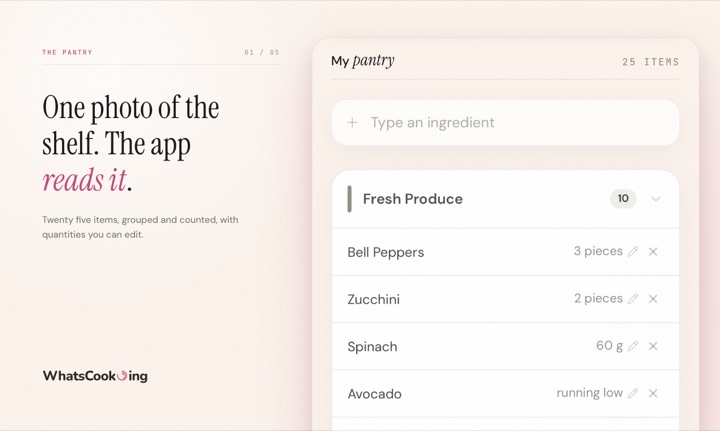
You answer a questionnaire once (diet, needs, goals, tastes, household and body metrics) and add your pantry by photo or by typing. A photo reads what it can see, and you can add or fix anything by hand. The app then writes a week of meals from your goals, your tastes and what is in your kitchen, with a picture for every recipe. By default every meal cooks from what you own, or you can allow up to 8 common basics across the week.
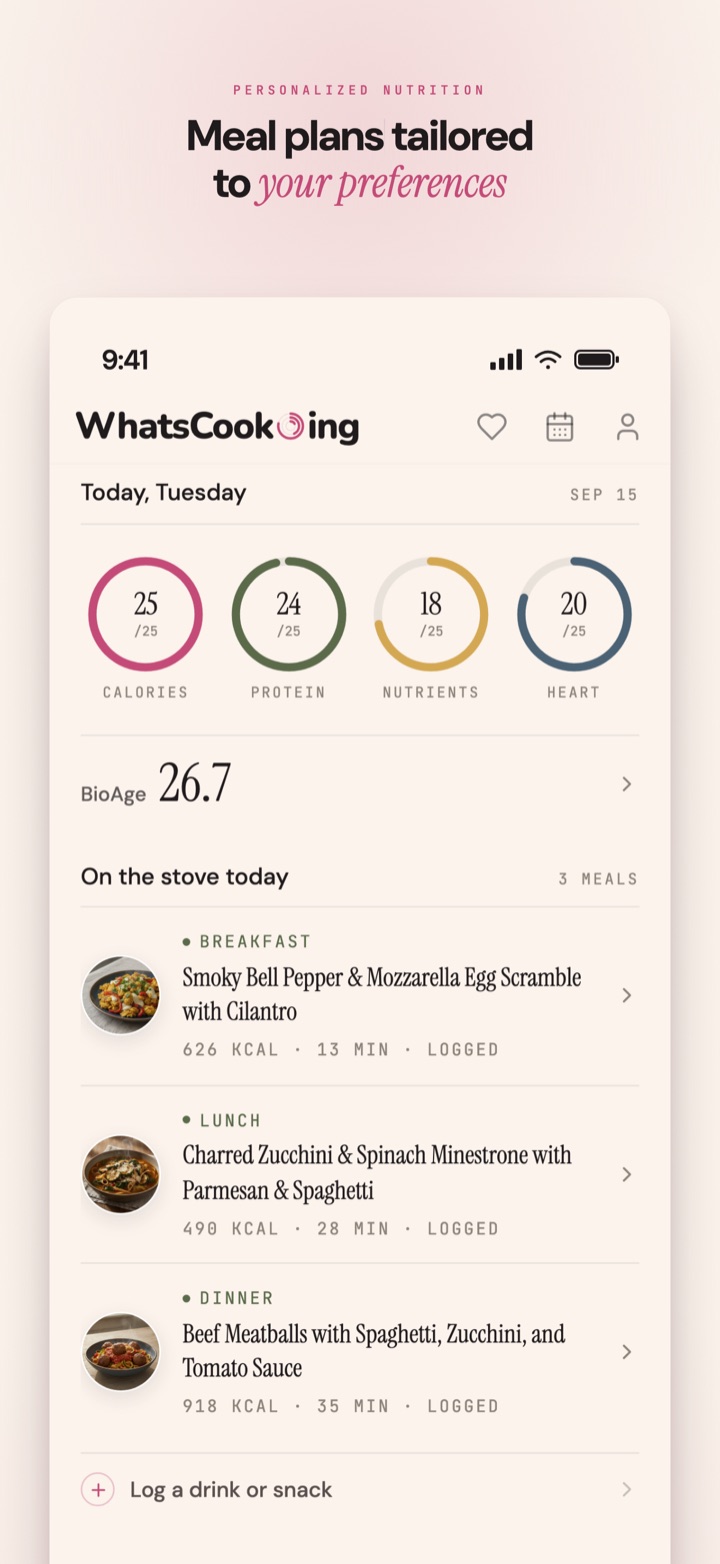
A planned meal you cooked logs with one tap, and anything else from a photo or a few typed words, so you never have to keep a food diary. Every logged meal is read for calories, protein, carbohydrate, fat, fiber, sugar and sodium, plus iron, calcium, vitamin C, vitamin D and omega 3. The day is scored across four pillars (calorie fit, protein, nutrients and heart), and the shopping list is led by your nutrient gaps.
Five AI meal planners, side by side.
The table scrolls sideways on a phone.
| App | Where the week starts | What it plans from | Grocery list | Tracks what you eat | Price | Platform |
|---|---|---|---|---|---|---|
| ChatGPT | A conversation | What you tell it, each time | When you ask for one | Not a tracker | Free app, with in-app purchases | iPhone, Android, web |
| Eat This Much | Your calorie and macro targets | Your diet goals, foods you like, budget and schedule | Automatic, with Instacart or AmazonFresh | Yes, what you did or did not eat, with Premium | Free for one day at a time. In-app purchases from $8.99 a month | iPhone, iPad, Mac, Android |
| Samsung Food | Recipes you save | Your saved recipes. Food+ adds plans to your health goals | Yes, from your plan | With Food+ | Free. Food+ $6.99 a month or $59.99 a year | iPhone, iPad, web |
| Klenz | The nutrients you are missing | The meals you log | Built around your nutrition, with Instacart in the US and Canada | Yes, 30+ nutrients | $4.99 a month or $29.99 a year, after a 7-day free trial | iPhone, Android, browser logging |
| WhatsCook.ing | Your kitchen and your goals | Your goals, your tastes and a pantry added by photo or typing | Led by your nutrient gaps | Yes, four pillars and a BioAge estimate | $29.99 a month or $179.99 a year, after a 7-day free trial | iPhone |
Pick by the part of the week you want off your plate.
If you want one week, once, and you are happy to describe your fridge, a chat assistant is quick and costs nothing extra. If an exact calorie and macro target is the whole point, Eat This Much is built around it and has been on the App Store since 2015. If you already have recipes you love, Samsung Food keeps them and plans from them for free.
If you log everything already and want the gaps closed for the least money, Klenz does that. If you want the week written from what is already in your kitchen, with every meal read back and the list led by what you were short on, that is the job WhatsCook.ing is built for.
What WhatsCook.ing does with AI, and what it costs.
It uses AI in two places, and says so. Anthropic's model writes the plan and your swaps, and Google Gemini reads your photos. The first time anything would go to either one, a sheet names both, and nothing is sent until you tap Continue. After writing, the app checks each meal against five diet rules (vegan, vegetarian, eggitarian, pescatarian and keto) and eight allergens, and sends a failing meal back to be rewritten. The check matches ingredient names, so it can miss a hidden source; if an allergy is medical, read every label.
Each day's four pillar scores fold into a BioAge figure, an estimate in years built from your age and the nutrition of the meals you log. BioAge is a nutrition-derived estimate, not a medical measurement.
It is $29.99 a month or $179.99 a year on the US App Store, after a 7-day free trial through your Apple Account; other App Store countries show local prices. Cancel at least 24 hours before the trial ends and you pay nothing.
Where WhatsCook.ing is the wrong pick.
If you want free, a chat assistant or the core of Samsung Food costs nothing. If you want plans to exact macros on Android, Eat This Much runs there. If you already log every meal and want gap-first lists for less, Klenz is $4.99 a month.
WhatsCook.ing is an iPhone app, with no Android version. It does not import your own recipes, scan barcodes or place grocery orders. The questionnaire is long, the first plan takes a few minutes to write, and swaps are capped at five a week.
Is there a free AI meal planner?
A chat assistant can write a week for free if you describe your diet, your goals and your fridge. Eat This Much's free account plans one day at a time. The core of Samsung Food is free for planning from recipes you save, and its AI-personalized plans come with Food+, at $6.99 a month on the US App Store. WhatsCook.ing has a 7-day free trial and no free tier.
Can ChatGPT make a meal plan and a grocery list?
Yes. Give it your diet, your goals and what is in the fridge, and it writes a week and a list in seconds. What it does not run for you is the loop around the plan: a pantry that counts down as you cook, a score for the meals you actually ate, and a list that leads with what you were short on. You bring those to the chat each week.
Is WhatsCook.ing just ChatGPT inside an app?
No, though it does use AI. Anthropic's model writes the plan and your swaps, and Google Gemini reads your photos. Around them, the app keeps your pantry, your logged meals and your targets. It checks each meal against five diet rules and eight allergens, and checks a recipe's calories and macros against USDA reference data when at least half of its ingredients match.
Which AI meal planner uses what is already in my fridge?
WhatsCook.ing reads a photo of your fridge or shelves into a pantry you can edit, then writes the week from it and from your goals. By default every meal cooks from what you own. Samsung Food+ lists pantry management, and Eat This Much Premium keeps a virtual pantry. Our fridge guide compares the ways apps learn what you own.
Do these apps work in the UK, Canada and Australia?
An app works wherever its App Store listing is sold. WhatsCook.ing is on the App Store in the US, the UK, Canada, Australia and India, at local prices: GBP 29.99 a month in the UK, CAD 39.99 in Canada and AUD 49.99 in Australia. Its shopping list opens at US store sites only; anywhere else you copy it as a plain list. Klenz's Instacart ordering covers the US and Canada.
Four pages that go deeper.
Ten apps in one table on the comparison page. To start from your shelves, a meal plan from what is in your fridge. If the nutrients matter most, meal planning apps that track nutrition and an app that builds your grocery list from your nutrient gaps.
Every figure above, and where it came from.
App prices, features and platforms are what Apple showed on the US App Store on 5 October 2026: ChatGPT, Eat This Much, Samsung Food, Klenz and WhatsCook.ing. Eat This Much's 30-second claim, grocery delivery and Android app are from its homepage, and Klenz's Android app and browser logging from its homepage, both read the same day. Prices at checkout are what you pay, so check them there.
On the App Store now.
Your week of meals planned from your goals, your tastes and your kitchen, every meal read nutrient by nutrient, and a shopping list led by your nutrient gaps.
Download on the App Store7-day free trial through your Apple Account, then $29.99 a month or $179.99 a year on the US App Store; other App Store countries show local prices. iPhone only.