Is there an app that builds a grocery list from my nutrient gaps?
Yes, a few. They differ in where the gaps come from and in what else ends up on the list.
Yes. Three apps, three ways to get there.
Yes. Klenz reads the meals you log against more than 30 nutrients and plans groceries around what you are missing. Eat This Much builds an automatic grocery list from a plan written to your calorie and macro targets. WhatsCook.ing, an iPhone app, plans your week and builds a shopping list led by your nutrient gaps, leaving out what your pantry already holds. It is $29.99 a month or $179.99 a year on the US App Store.
We make one of these apps, so read this as a competitor's guide. Section five says where ours is the wrong pick, and Klenz does this for less money.
A list that starts from what your meals were short on.
A normal grocery list starts from recipes: the dishes you plan, minus what you have. A gap-led list starts one step earlier, from what you actually ate. It looks at your meals over a few days, finds the nutrients that came in below target, and puts the foods that close those gaps at the top of the list.
That needs two things: a record of what you ate, and a target for each nutrient. Without the record, the app is guessing. Without the target, there is no gap to close. Klenz and WhatsCook.ing get the record from the meals you log. Eat This Much skips the gap step and builds its list from the plan it writes.
Doing it yourself, without an app.
Write down everything you eat for a typical week, look up the nutrients, and compare your daily averages with the recommended intake for your sex and age. The NIH Office of Dietary Supplements publishes a fact sheet for each vitamin and mineral, with its recommended intakes and the foods richest in it. Put two or three of those foods on next week's list, and check again a week later.
It works, and it is slow. Most of the effort is the record, which is the part an app can take off your hands.
Klenz: gaps first, for the least money.
Klenz is an AI nutrition tracker. You log meals by photo, voice or search, and its App Store listing says it "scores every meal, maps 30+ nutrients to 7 areas, and plans meals and groceries around what you're missing". Its homepage describes "AI-built plans for your gaps", then sending the cart to Instacart, which its listing says works in the US and Canada.
It is $4.99 a month or $29.99 a year after a 7-day free trial on the US App Store, and runs on iPhone and Android, with logging from a browser too. If you already log every meal and mainly want the gaps closed, it is the cheapest way here.
Eat This Much: a list from your macro plan.
Eat This Much works the other way round. It writes the meals first, to your calorie and macro targets, and the list follows: "Automatic grocery lists", its homepage says, with an "Instacart or AmazonFresh integration". The list is built from the plan rather than from the gaps in what you ate, so it suits someone whose main goal is hitting macros. On the US App Store, in-app purchases start at $8.99 a month.
WhatsCook.ing: gaps first, on top of a week planned from your kitchen.
WhatsCook.ing plans the week from your goals, your tastes and what is in your kitchen, then reads every meal you log for calories, protein, carbohydrate, fat, fiber, sugar and sodium, plus iron, calcium, vitamin C, vitamin D and omega 3. Vitamin and mineral targets follow NIH recommended intakes for your sex and age.
The shopping list leads with the foods that close your nutrient gaps, then what is running low in your pantry, what your daily routines use up this week, pantry staples your recipes lean on, produce in season near you, and recipe essentials for your cuisines. What your pantry already holds is left off. In the US, each item opens a search at Walmart, Instacart, Amazon Fresh and more US stores; anywhere, you can copy the list as it is.
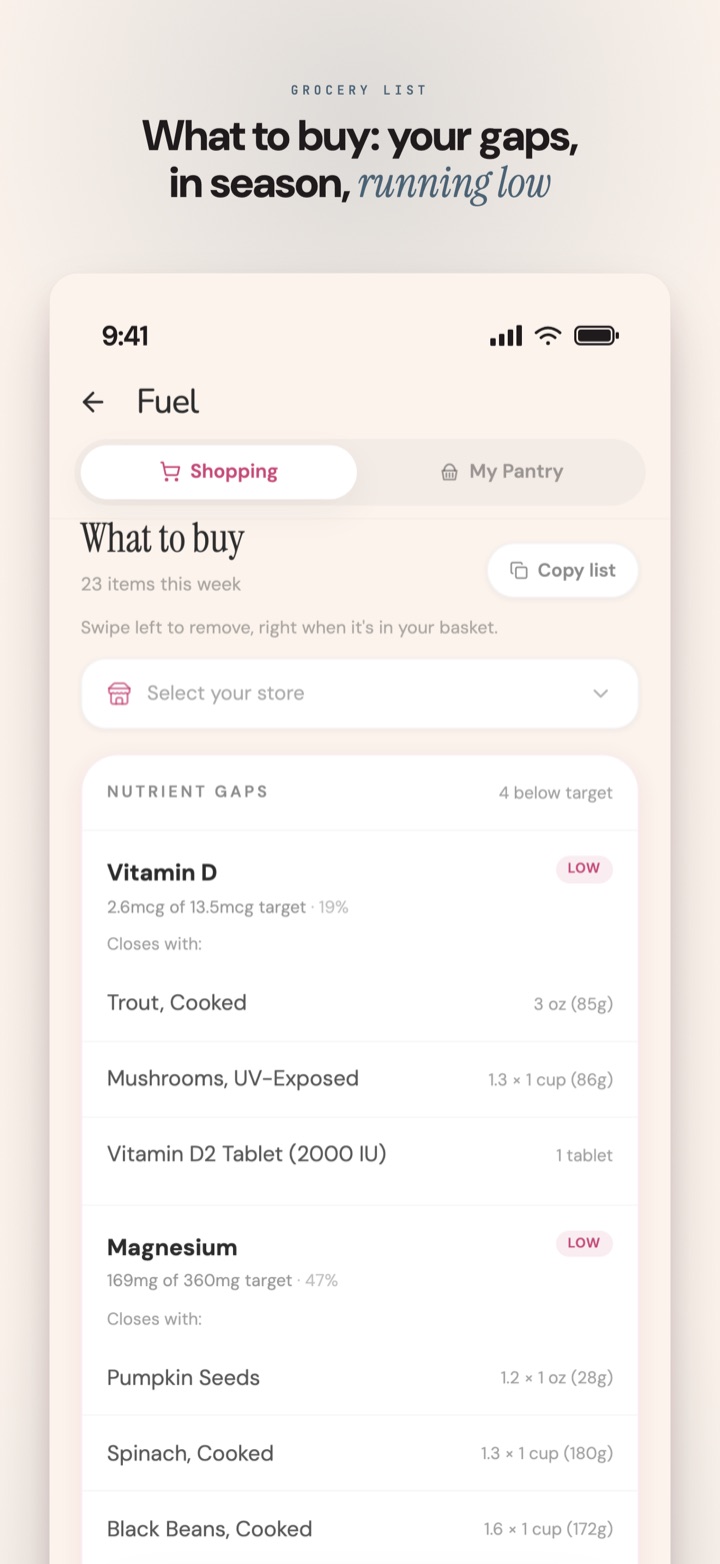
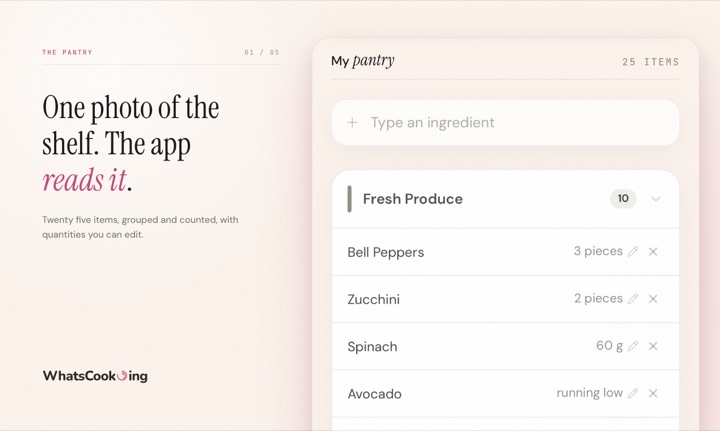
Three gap-aware lists, side by side.
The table scrolls sideways on a phone.
| App | Where the gaps come from | What the list is built from | Leaves off what you own | Ordering | Price | Platform |
|---|---|---|---|---|---|---|
| Klenz | The meals you log, across 30+ nutrients | What you are missing | Not stated | Instacart in one tap, US and Canada | $4.99 a month or $29.99 a year, after a 7-day free trial | iPhone, Android, browser logging |
| Eat This Much | No gap step; the plan is written to your calorie and macro targets | The meals in your plan | Not stated. Premium keeps a virtual pantry | Instacart or AmazonFresh | Free for one day at a time. In-app purchases from $8.99 a month | iPhone, iPad, Mac, Android |
| WhatsCook.ing | The meals you log, against targets for your sex and age | Your nutrient gaps first, then what is running low, routines, staples, produce in season and cuisine essentials | Yes, your pantry is left off | No orders. Opens a search at Walmart, Instacart, Amazon Fresh and more US stores, or copies as a plain list | $29.99 a month or $179.99 a year, after a 7-day free trial | iPhone |
Why the list sits on a week of meals.
A gap list on its own tells you what to buy. It does not tell you what to cook with it. In WhatsCook.ing the list sits on a week of meals written from your goals, your tastes and what is in your kitchen, so the list arrives with a week of meals to cook, and the meals you then log feed next week's gaps.
Logging takes one tap for a planned meal you cooked, and a photo or a few typed words for anything else, so you never have to keep a food diary or weigh anything. It is $29.99 a month or $179.99 a year on the US App Store, after a 7-day free trial through your Apple Account; other App Store countries show local prices. Cancel at least 24 hours before the trial ends and you pay nothing.
Where WhatsCook.ing is the wrong pick.
If you already log every meal and want gap-first lists for less money, Klenz does that at $4.99 a month, about a sixth of our monthly price. If you want groceries ordered in one tap, Klenz and Eat This Much both send lists to Instacart; WhatsCook.ing opens store searches but places no orders, and its store links are US sites only.
The list is not a full recipe list either. Basics you allow for a recipe are marked To buy on that recipe's card, not added to the list. WhatsCook.ing is an iPhone app, with no Android version, and it does not import your own recipes or scan barcodes.
How do I find my nutrient gaps?
Record what you eat for a typical week, then compare your daily averages with the recommended intakes for your sex and age. The NIH Office of Dietary Supplements publishes those intakes, and a food-source list, for each vitamin and mineral. An app that reads your meals does the comparison for you. WhatsCook.ing sets vitamin and mineral targets from NIH recommended intakes for your sex and age, and works out your gaps from the meals you log.
Which nutrients does WhatsCook.ing read?
Every logged meal is read for calories, protein, carbohydrate, fat, fiber, sugar and sodium, plus iron, calcium, vitamin C, vitamin D and omega 3. Calories come from the Mifflin-St Jeor formula, protein from your body weight raised by the goals you chose, and the heart limits are informed by AHA and DASH guidance.
Does the list include the ingredients for my recipes?
Not as a section of its own. By default every meal cooks from what you own. If you allow a few basics, up to 8 common items across the week, each one is marked To buy on its own recipe card. The shopping list holds the foods that close your nutrient gaps, then what is running low, what your routines use up, pantry staples, produce in season near you and recipe essentials for your cuisines.
Can the app order my groceries?
WhatsCook.ing does not place orders. In the US, each item opens a search at the store you pick: Walmart, Amazon Fresh, Instacart, DoorDash, Target, Kroger or Trader Joe's. Anywhere, you can copy the list or take it into a store as it is. If ordering in one tap matters most, Klenz sends its list to Instacart in the US and Canada, and Eat This Much works with Instacart and AmazonFresh.
Is a list built from my gaps medical advice?
No. It is a shopping suggestion from the meals you log, measured against general recommended intakes. It is not a test, a diagnosis or a treatment. If you think you have a deficiency, or an allergy or condition shapes what you eat, ask a clinician, and read labels.
Does it work in the UK, Canada and Australia?
Yes, at local prices: GBP 29.99 a month in the UK, CAD 39.99 in Canada and AUD 49.99 in Australia, on the App Store. The gap-led list works the same way everywhere. Its store links are US store sites, so outside the US you copy it as a plain list.
Four pages that go deeper.
For the trackers side by side, meal planning apps that track nutrition. For every kind of AI planner, the best AI meal planner apps, by where the week starts. If protein is the gap, a high-protein meal plan with a grocery list. And ten apps in one table on the comparison page.
Every figure above, and where it came from.
App prices, features and platforms are what Apple showed on the US App Store on 5 October 2026: Klenz, Eat This Much and WhatsCook.ing. Klenz's gap plans, Android app and browser logging are from its homepage, and Eat This Much's grocery lists and delivery from its homepage, both read the same day. Recommended intakes and food sources are from the NIH Office of Dietary Supplements. "About a sixth" is Klenz's $4.99 against our $29.99, both monthly prices on the US App Store.
On the App Store now.
Your week of meals planned from your goals, your tastes and your kitchen, every meal read nutrient by nutrient, and a shopping list led by your nutrient gaps.
Download on the App Store7-day free trial through your Apple Account, then $29.99 a month or $179.99 a year on the US App Store; other App Store countries show local prices. iPhone only.