Can an app estimate your biological age from what you eat?
Yes, as a rough guide and nothing more. What these numbers read, what the research says about food, and how ours works.
An estimate from your meals, not a reading of your body.
Only as an estimate, and not a medical one. Several biological age apps start from body data: SuperAge reads Apple Health measures such as resting heart rate and VO2 max, and InsideTracker works from blood tests. WhatsCook.ing's BioAge is a nutrition-derived estimate, not a medical measurement: it starts from your age and moves with the nutrition of the meals you log, smoothed over your history. iPhone, $29.99 a month on the US App Store.
We make WhatsCook.ing, so read this as a guide by one of the apps in it. It is general information, not medical advice.
Three kinds of biological age, by what goes in.
"Biological age" is not one measurement. Each tool picks its own inputs and its own formula, so two tools can give the same person two different numbers. The useful question is what each one reads.
- Body data from a phone or watch. SuperAge's listing says it shows "your body age, fitness age, and metabolic age, all from Apple Health", tracking resting heart rate, VO2 max, blood oxygen and body temperature. It can also read a blood test PDF you upload, with two algorithms, PhenoAge and KDM. Its first biological age calculation is free; deeper analyses need Premium.
- Blood tests. InsideTracker turns "your blood, DNA, and fitness tracker data" into recommendations, including InnerAge, its analysis of your body's age. You buy the tests through it or upload results you already have.
- Your meals. WhatsCook.ing's BioAge measures none of these. It starts from your age and moves with the nutrition of the meals you log.
One naming note: a separate App Store app is called BioAge: Health Tracker. It is not ours. On this page, BioAge means the estimate inside WhatsCook.ing.
Food can move some of these measures, a little.
The best trial evidence so far is about how much people eat. In the CALERIE trial, 220 adults without obesity were randomly assigned to eat 25 percent fewer calories, or to eat as usual, for two years. Calorie restriction slowed the pace of aging as measured by DunedinPACE, a DNA methylation measure taken from blood, but did not significantly change biological age on other clocks, including PhenoAge and GrimAge. The authors call the effects small.
Two things follow. No app can measure your biology from your meals: a food-based number is a summary of how you eat, not a reading of your body. And this is not a reason to cut calories on your own. Talk to a clinician before a big change.
How the BioAge estimate in WhatsCook.ing is built.
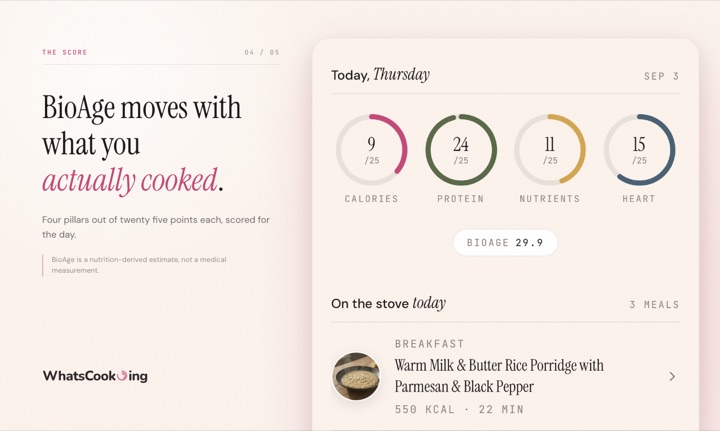
Every meal you log is read for calories, protein, carbohydrate, fat, fiber, sugar and sodium, plus iron, calcium, vitamin C, vitamin D and omega 3. Each day is then scored on four pillars, 25 points each:
- Calorie fit. How close the day came to your calorie target, set with the Mifflin-St Jeor formula.
- Protein. How far you got toward a target set from your body weight, raised by the goals you chose. Full marks once you reach it.
- Nutrients. The average of six items, fiber, iron, calcium, vitamin C, vitamin D and omega 3, each against its target. Vitamin and mineral targets follow NIH recommended intakes for your sex and age.
- Heart. Sodium and sugar count against you, fiber and omega 3 count for you, with limits informed by AHA and DASH guidance.
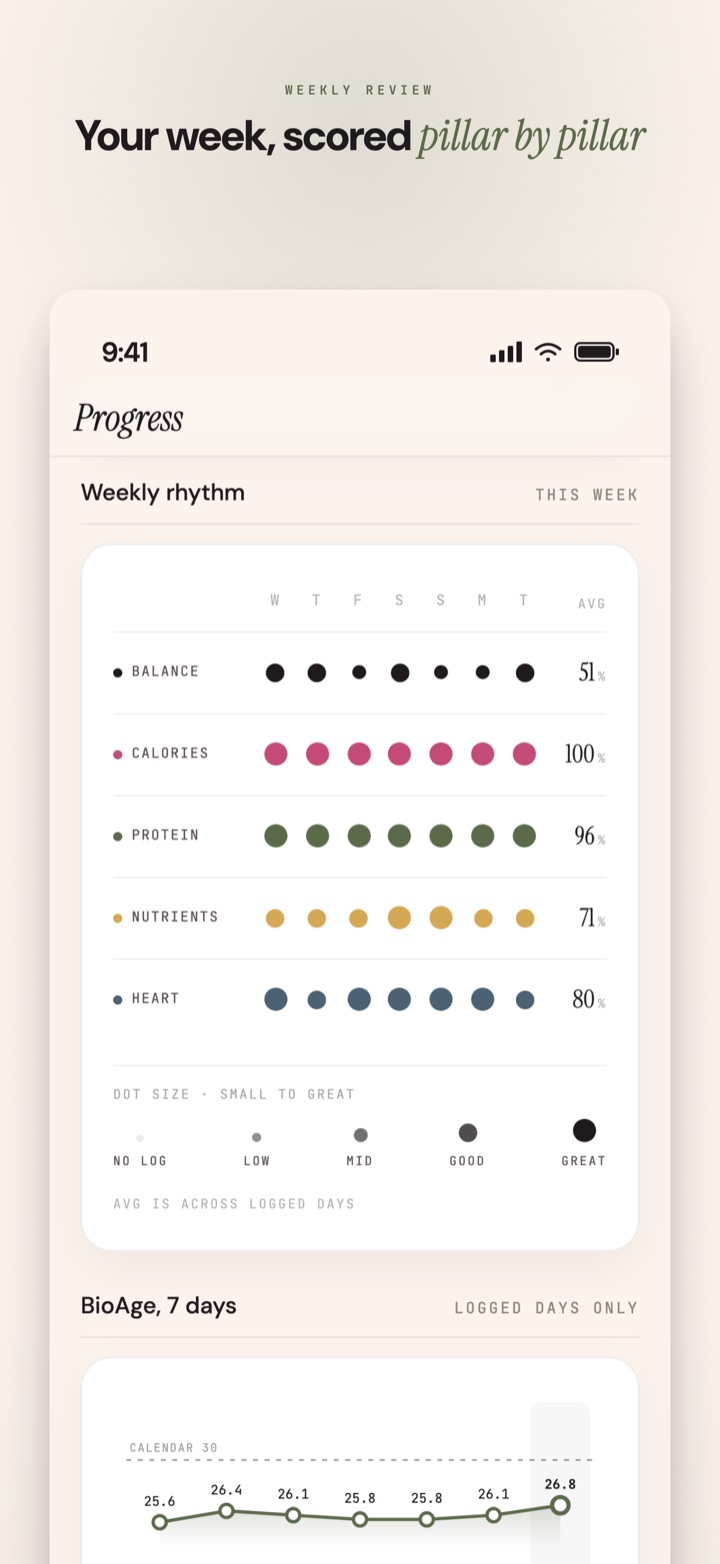
That score sets how far your BioAge sits above or below your actual age. It is smoothed over your history, so one day moves it a little, and shown to one decimal so you can see the movement. The full method opens from How is your BioAge calculated, on Home in the app.
What it costs, and where it is the wrong pick.
WhatsCook.ing is $29.99 a month or $179.99 a year on the US App Store, after a 7-day free trial through your Apple Account. BioAge comes with the meal plans, the nutrient tracking and the shopping list led by your nutrient gaps; it is not sold on its own.
- You want a measure of your body. BioAge does not measure your heart, your fitness or your blood. For that, see a clinician, or a tool built on those inputs.
- You rarely cook. The app is built around meals you cook. You can log other food from a photo or a few words, but a planned week is where it does most.
- You use Android. It is an iPhone app.
Is BioAge a medical test?
No. WhatsCook.ing's BioAge is an estimate in years, built from your age and the nutrition of the meals you log. It is not a medical measurement, not a diagnosis and not a substitute for a clinician. The app itself tests nothing, and no current screen collects lab results.
Can changing your diet lower your biological age?
The evidence is early. In the CALERIE trial, 220 adults without obesity were assigned to eat 25 percent fewer calories, or their usual diet, for two years. Calorie restriction slowed one blood measure of the pace of aging, DunedinPACE, but did not significantly change the PhenoAge or GrimAge clocks, and the effects were small. Talk to a clinician before a big change to how you eat.
Is WhatsCook.ing the same as the BioAge: Health Tracker app?
No. BioAge: Health Tracker is a separate App Store app from a different developer. BioAge in WhatsCook.ing is the name of the age estimate inside our app, which is listed on the App Store as WhatsCook.ing: Nutrition Coach.
Why does my BioAge move a little every day?
Each day you log is scored across four pillars, calorie fit, protein, nutrients and heart, 25 points each. That score sets how far the estimate sits above or below your actual age. It is smoothed over your history, so one good or poor day moves it a little, and it is shown to one decimal so that small movement is visible.
Where can I see how WhatsCook.ing calculates BioAge?
In the app. The method opens from How is your BioAge calculated, on Home.
Three pages that go deeper.
For the nutrients behind the Nutrients pillar, how to track iron, calcium and vitamin D without a food diary. For the Protein pillar, a high-protein meal plan with a grocery list. And for short answers about the app, the questions page.
Every figure above, and where it came from.
SuperAge, InsideTracker and BioAge: Health Tracker are described from their US App Store listings, read on 5 October 2026: SuperAge, InsideTracker and BioAge: Health Tracker. The trial is Waziry and others, "Effect of long-term caloric restriction on DNA methylation measures of biological aging in healthy adults from the CALERIE trial", Nature Aging, 2023 (free full text). How WhatsCook.ing builds BioAge is described from the app itself.
On the App Store now.
Your week of meals planned from your goals, your tastes and your kitchen, every meal read nutrient by nutrient, and a BioAge estimate that moves with the meals you log.
Download on the App Store7-day free trial through your Apple Account, then $29.99 a month or $179.99 a year on the US App Store; other App Store countries show local prices. iPhone only.