How can you tell if you get enough vitamin D, iron and calcium without a food diary?
Three nutrients, three short lists of foods, and one week of meals to check them against. No scale, no daily log.
Check a week of meals against the NIH amounts.
Look at a week, not a day: compare your usual meals with NIH recommended intakes for your sex and age. Cronometer reports 95+ vitamins and minerals if you log each food against its database. WhatsCook.ing plans your week, logs a planned meal with one tap, reads every logged meal for iron, calcium, vitamin D, vitamin C, omega 3 and more, and builds a shopping list led by your nutrient gaps. iPhone, $29.99 a month on the US App Store.
We make WhatsCook.ing, so read this as a guide by one of the apps in it. It is general information, not medical advice, and section five says where our app is the wrong pick.
The NIH amounts for adults.
These are the average daily amounts the NIH Office of Dietary Supplements recommends. Pregnancy and breastfeeding change some of them; the fact sheets linked below list every case.
The table scrolls sideways on a phone.
| Nutrient | Ages 19 to 50 | Ages 51 to 70 | Ages 71 and over | Worth knowing |
|---|---|---|---|---|
| Vitamin D | 15 mcg (600 IU) | 15 mcg (600 IU) | 20 mcg (800 IU) | Your skin also makes it in sunshine, so food is only part of the picture |
| Iron | Men 8 mg, women 18 mg | 8 mg | 8 mg | 27 mg in pregnancy. Almost twice as much if you eat no meat, poultry or seafood |
| Calcium | 1,000 mg | Men 1,000 mg, women 1,200 mg | 1,200 mg | Vitamin D helps your body absorb it |
No diary: count the good sources across one week.
You do not need to weigh anything to spot a gap. Write down a normal week of meals, the one you are about to cook or the one you just ate, and look for these foods in it. Where a nutrient has no good source all week, that is the gap to fill first.
- Vitamin D. Fatty fish such as trout, salmon, tuna and mackerel; fortified milk, at about 3 mcg (120 IU) a cup in the US; fortified cereals and plant milks; mushrooms exposed to ultraviolet light.
- Iron. Lean meat, seafood and poultry; iron-fortified cereals and breads; white beans, lentils, spinach, kidney beans and peas; nuts and raisins. Eat plant iron with citrus, strawberries, sweet peppers, tomatoes or broccoli, whose vitamin C helps you absorb it.
- Calcium. Milk, yogurt and cheese; canned sardines and salmon with the bones; kale, broccoli and bok choy; fortified soy and almond drinks, and some brands of tofu.
Labels vary, so check the Nutrition Facts panel on anything fortified. And remember what this check can and cannot tell you: it shows what you eat, not what is in your blood. Sunshine and supplements count too, and the NIH points to a blood test as the way to know your vitamin D level.
Precise logging, or a planned week that logs in one tap.
Cronometer is the precise option. Its listing says it tracks "95+ vitamins and minerals" from a database of more than 1.1 million verified foods, with a free barcode scan, and photo and voice logging listed with Gold. You keep a detailed food diary, and in return you get every nutrient to a decimal. It is free, with Gold at $10.99 a month or $59.99 a year on the US App Store.
WhatsCook.ing starts from the other end. It writes your week of meals, and a planned meal you cooked logs with one tap; a drink, a snack or a meal out logs from a photo or a few typed words. You never have to keep a food diary or weigh anything. Every logged meal is read for calories, protein, carbohydrate, fat, fiber, sugar and sodium, plus iron, calcium, vitamin C, vitamin D and omega 3, against targets that follow NIH recommended intakes for your sex and age.
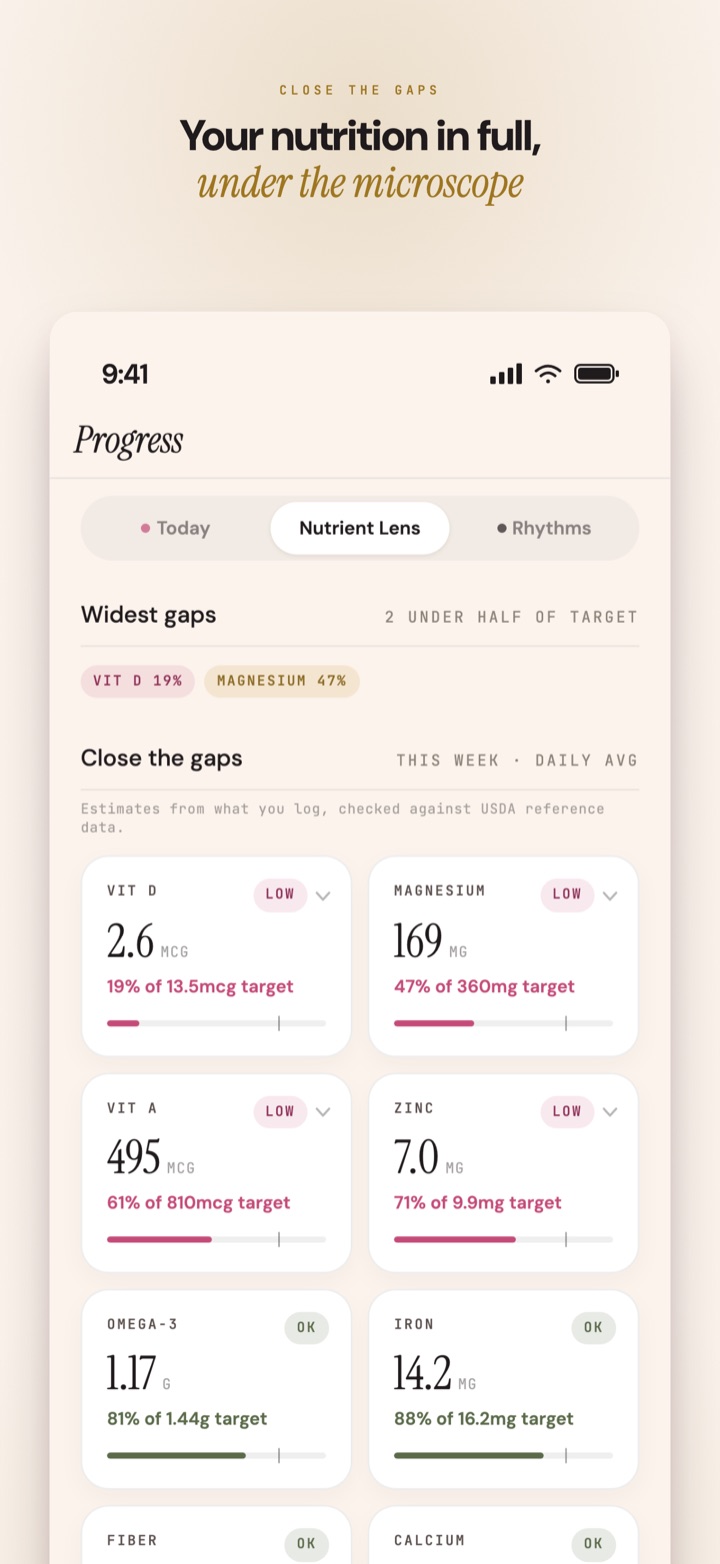
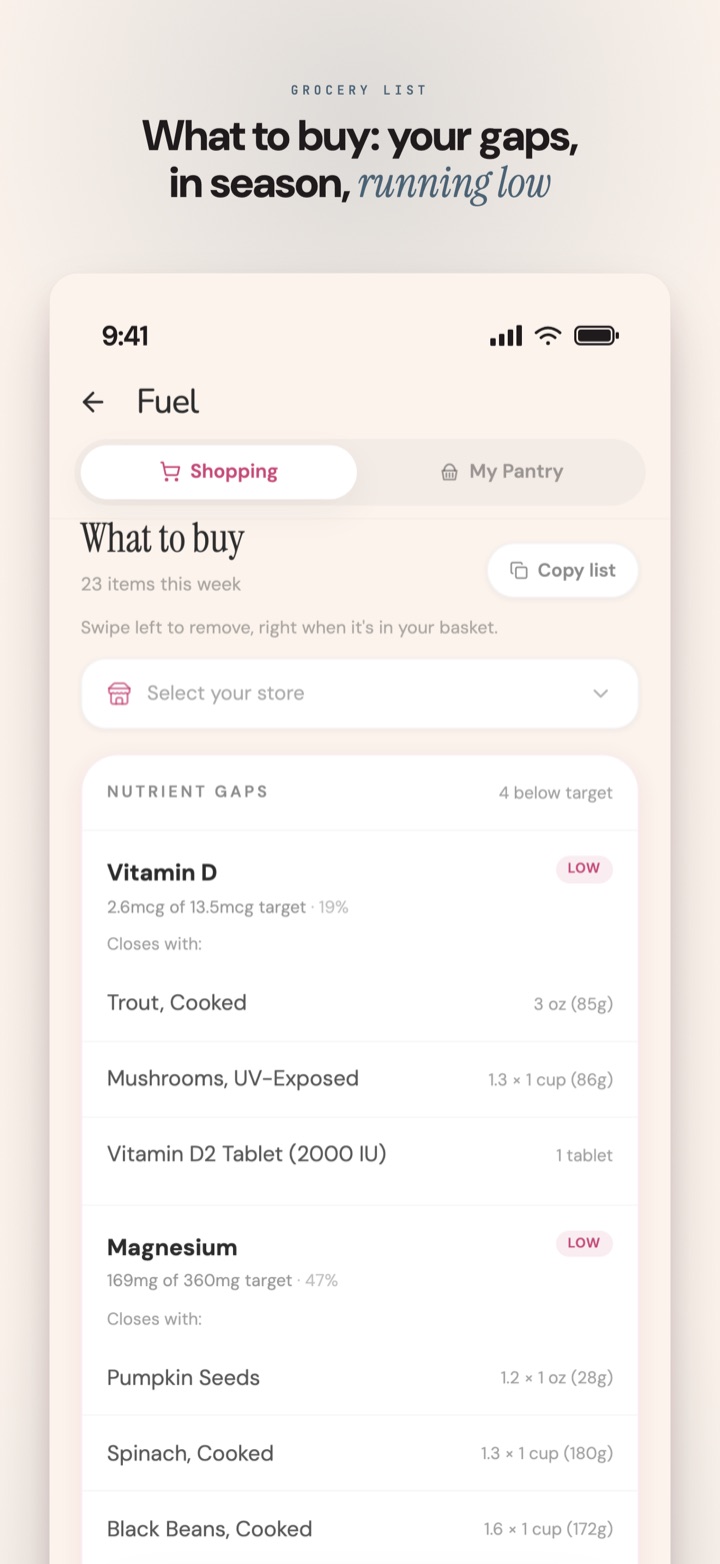
The Nutrient Lens on the Progress tab shows each nutrient's daily average for the week against its target, widest gaps first. The shopping list then leads with the foods that close those gaps, followed by what is running low in your pantry.
What WhatsCook.ing costs, and where it is the wrong pick.
It is $29.99 a month or $179.99 a year on the US App Store, after a 7-day free trial through your Apple Account. Cancel at least 24 hours before the trial ends and you pay nothing.
- You want every vitamin and mineral. Cronometer reports 95+ of them for less money. WhatsCook.ing reads iron, calcium, vitamin C, vitamin D and omega 3, plus calories, protein, carbohydrate, fat, fiber, sugar and sodium.
- You are vegetarian and watching iron. Our iron target follows the NIH table by sex and age, and the NIH says you need almost twice that, so aim above the target the app shows.
- You need to know a blood level. No food tracker can tell you that. Ask a clinician about a test.
- You use Android, or you rarely cook. It is an iPhone app, built around meals you cook.
How do I know if I am low in vitamin D?
A blood test is the way to know. The NIH explains that you get vitamin D from food, sunshine and supplements, so one way to know if you are getting enough is a blood test that measures it. Tracking food tells you what you ate, not what is in your blood, so ask a clinician if you are worried.
Which foods have the most vitamin D?
Very few foods have much of it naturally. The NIH names fatty fish such as trout, salmon, tuna and mackerel among the best natural sources. Almost all US milk is fortified with about 3 mcg (120 IU) a cup, and vitamin D is added to many breakfast cereals and some brands of orange juice, yogurt and plant milks. Some mushrooms are exposed to ultraviolet light to raise their vitamin D.
How can I get more iron as a vegetarian?
Eat white beans, lentils, spinach, kidney beans, peas and iron-fortified cereals and breads, alongside a food with vitamin C, such as citrus, strawberries, sweet peppers, tomatoes or broccoli, which helps your body absorb iron from plants. The NIH says people who eat no meat, poultry or seafood need almost twice the amount in its table.
Can an app track micronutrients without logging every food?
WhatsCook.ing comes close: it plans your week, a planned meal you cooked logs with one tap, and anything else logs from a photo or a few typed words, so you never keep a food diary or weigh anything. Each meal is then read for iron, calcium, vitamin C, vitamin D, omega 3 and more. Cronometer reports more nutrients, but you log each food against its database.
Does it work in the UK, Canada or Australia?
Yes. WhatsCook.ing is on the App Store in the US, the UK, Canada, Australia and India, at local prices: GBP 29.99 a month in the UK, CAD 39.99 in Canada and AUD 49.99 in Australia. The NIH amounts on this page are US guidance; your own country may set slightly different ones.
Three pages that go deeper.
If protein is the goal, a high-protein meal plan with a grocery list. To compare trackers and planners, which meal planning apps track nutrition. And if you log meals from photos today, a Cal AI alternative for people who cook at home.
Every figure above, and where it came from.
The recommended amounts, food sources and the note on blood tests are from the NIH Office of Dietary Supplements consumer fact sheets on vitamin D, iron and calcium, read on 5 October 2026. Cronometer's figures and prices are from its US App Store listing, and WhatsCook.ing's from ours, read the same day.
On the App Store now.
Your week of meals planned from your goals, your tastes and your kitchen, every meal read nutrient by nutrient, and a shopping list led by your nutrient gaps.
Download on the App Store7-day free trial through your Apple Account, then $29.99 a month or $179.99 a year on the US App Store; other App Store countries show local prices. iPhone only.